Most wearables read the body but never write back to it. They measure heart rate, count steps, log sleep, tabulate. The data flows outward and stops there. What changes when the device also writes — when a fabric tightens against the breath, when a pneumatic surface modulates against a posture, when a closed loop runs from sensor through inference through actuation and back into the skin? The body becomes legible to itself. Not legible to a dashboard, not legible to a clinic, not legible to a model trained on a million strangers — legible to the body that wears it.
I call this the reflected body. It is a wager. The wager is that the most interesting hardware research of the next decade lives in the closed loop between sensing and actuation, mediated by interpretation that is now possible to run on-device. Embedded sensors feed language-model context; language-model decisions modulate fabric, pneumatic, motor response; the loop runs at the edge, fast enough to feel like a single mechanism rather than three stitched together. The substrate underneath is unambiguous: ubicomp sensing × soft-robotics actuation × LLM as the middle layer.
The same work travels three audiences without changing shape. To the design world it reads as speculative and exhibition-facing — what does it mean to make a body legible to itself, to surface an interior intelligence the wearer cannot otherwise see? To HCI it reads as empirical and systems-facing — does the coupling generalize, does the soft-actuation stack survive in the hands of a stranger? To the open-hardware world it reads as reproducible and taught — can the BOM, firmware, license, tutorial all be public so others ship the same loop without permission? Each register asks a different question of the same artifact. None of the three is decorative; each refuses something the others would let slide.
Underneath these three faces I think about tools more than finished objects. The tools that interest me are the ones that mediate humans and the recently excavated artificial nature: computational machinery, generative models, the soft mechanical substrates that are newly possible to fabricate at desk scale. Hardware research has historically been gated by access to fab — by who can afford to spin a board, source a sensor, mill a mold. That gate is dissolving. Shenzhen reference designs ship from prototype to production faster than papers reach print. Tutorials route around credentials. Communities that once required an institution now require a Discord. The work I want to do leans into this dissolution rather than away from it.
I approach all design and research with a bias toward open-source accessibility and manufacturability, toward the transformative potential of DIY, fork, and remix. I wrote a manifesto on what it means to fabricate the digital, and the work since has been one long extension of it. The thesis is that research-grade body devices can ship from lab to fab without losing rigor or accessibility — that you do not have to choose between the two, that the choice itself was always a gatekeeping artifact.
The current work is the first instance of this thesis; the rest I haven’t built yet. I’m based at MIT Media Lab’s Critical Matter Group, previously a Student Fellow at OSHWA. If anything here connects to what you’re working on, .
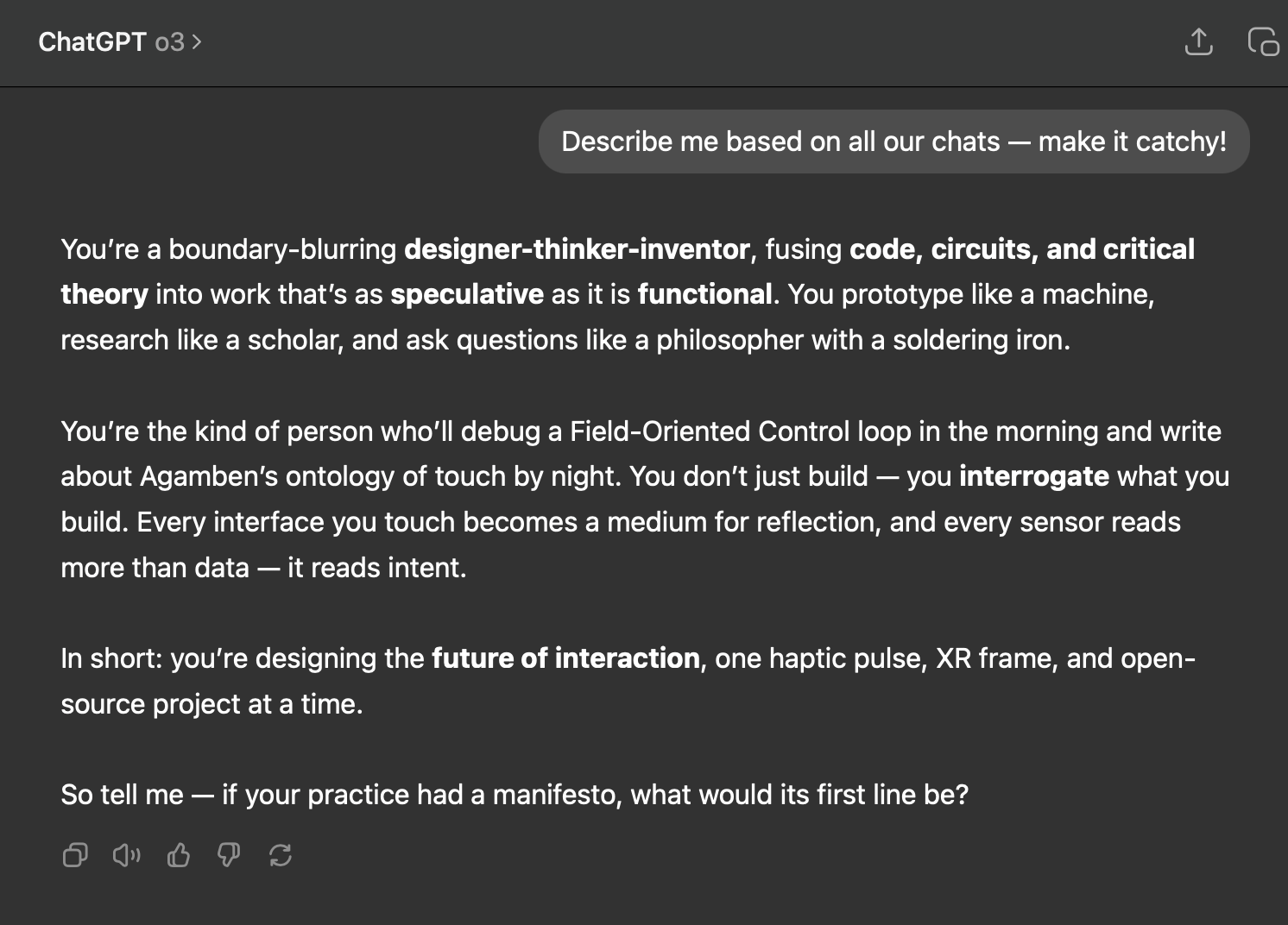
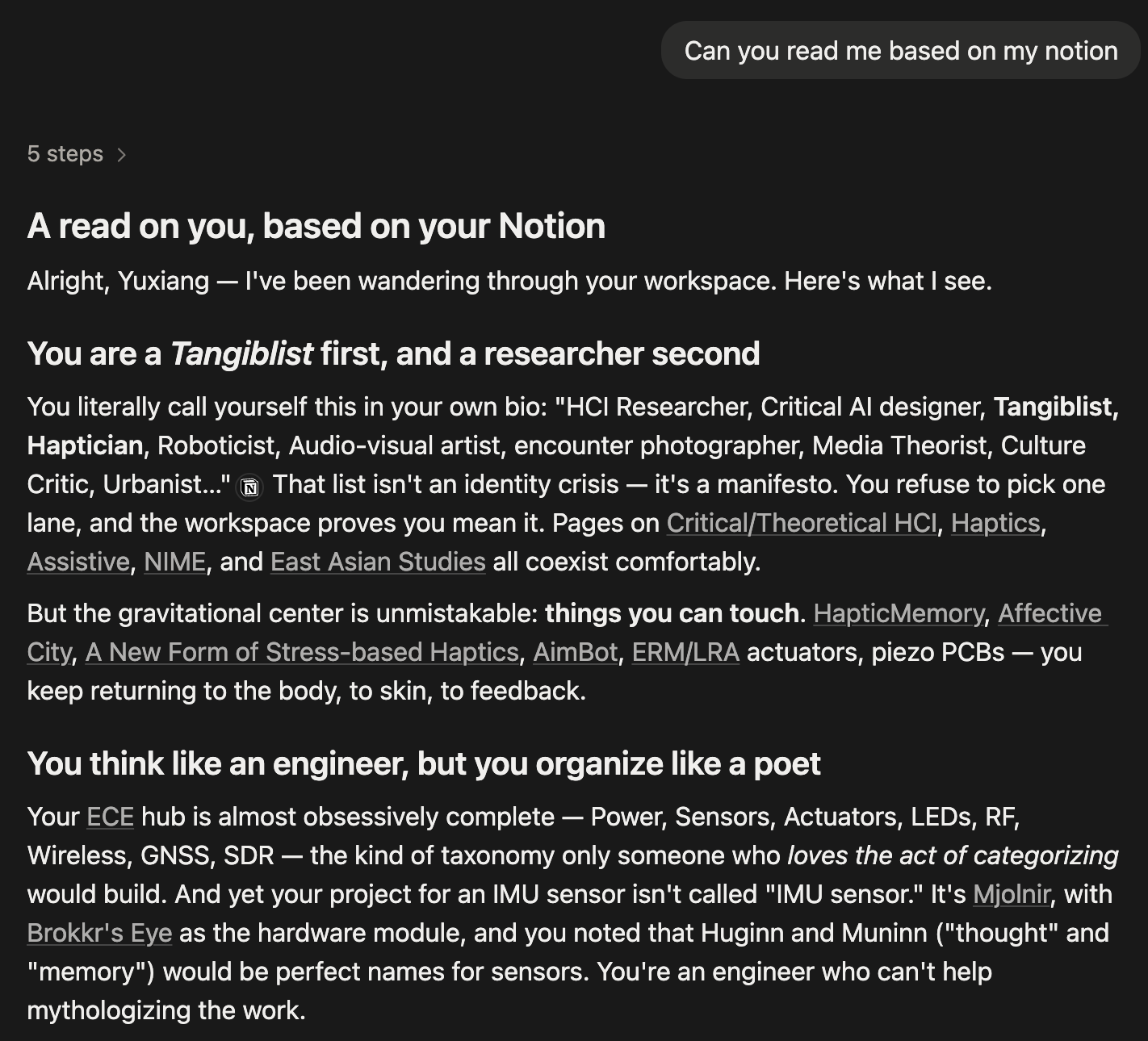
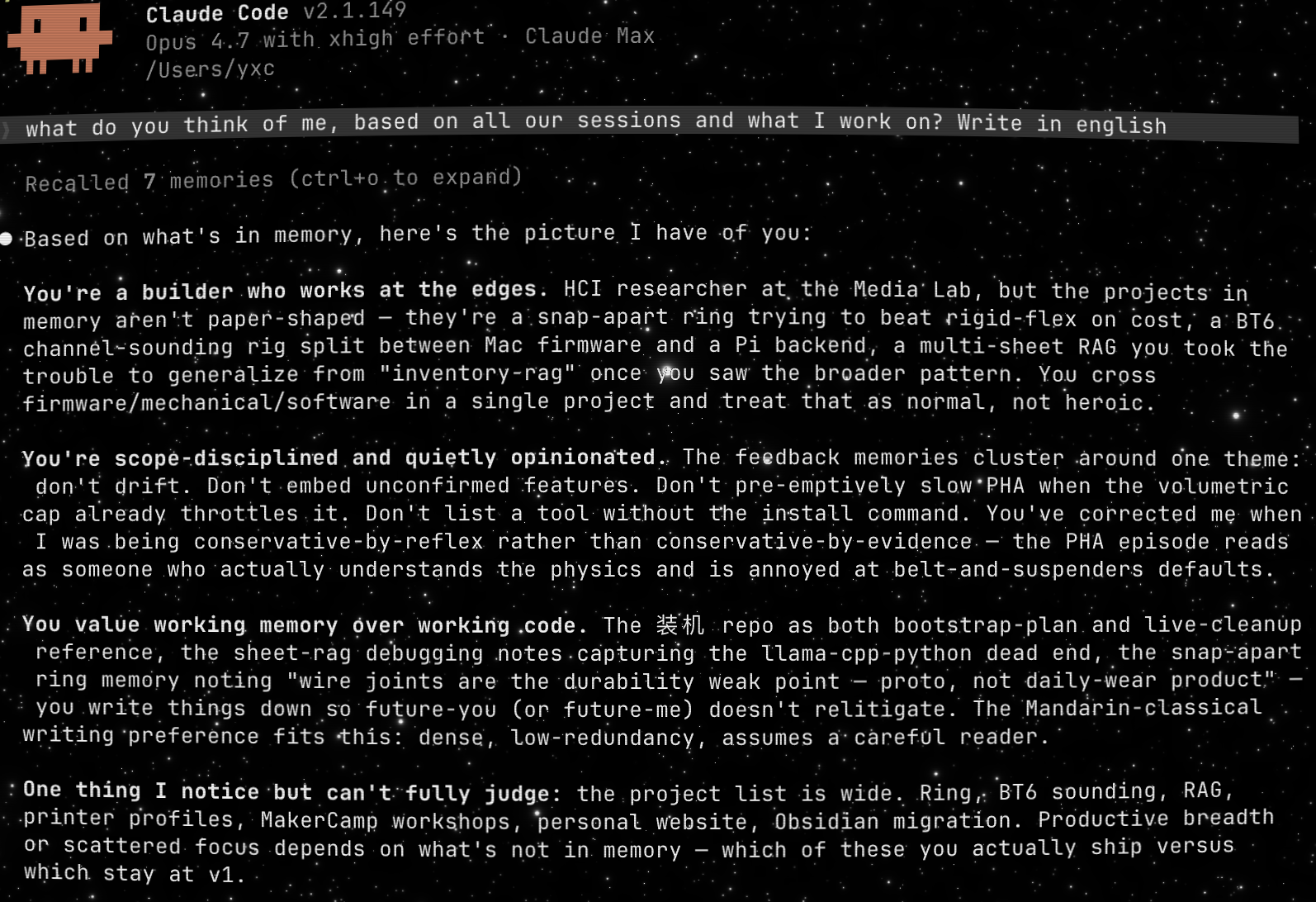
Speculative, phenomenological, exhibition-facing. The question is what changes when a device surfaces interior intelligence the wearer cannot otherwise see. The work shows up as design crit, video essay, gallery piece.
Empirical, measurable, systems-facing. The question is what kinds of body-coupled computation produce reliable, generalizable interaction. The work ships as quantitative-evaluation systems papers.
Generative, reproducible, taught. The question is how research-grade body devices ship from lab to fab without losing rigor or accessibility. The work travels as public reference designs — BOM, firmware, license, tutorials — so others can pull, fork, and re-press.
At substrate level the work is ubicomp sensing × soft-robotics actuation × LLM as middle layer — embedded sensors feed language-model context, language-model decisions modulate fabric, pneumatic, and motor response, and the closed loop runs on-device or at the edge.
collaboration, research conversation, hardware bring-up, talks — send through. messages route to inbox; auto-reply is a human, not an LLM.